Arien Roosa and the Esopus Mutiny by J.E. Rose
- revjerose
- 4 days ago
- 4 min read
I

Historical Note: The stories that are extant of Aldert Roosa and his adventures are begging to be made into action movies--or at least a comic book. That's what I've done in this chronicle, based on a true event involving Aldert and his son Arien. Though the historic events called the Esopus Wars primarily involved the Dutch and the Lenape Indians, that was only part of the powder keg in Wiltwyk (Kingston). In this story, I've focused on the British connection. This story of the canoe is recorded in the historic Roosa Family Bible.
Wiltwyk Dutch Settlement 1664
It was 1664, and the flag of the Dutch West India Company had barely hit the dirt before the redcoats marched in, claiming New Netherland as "New York." For young Arien Roosa, watching foreign soldiers swagger past the wooden stockade felt like an open wound. The Dutch burghers were forced to nod, swallow their pride, and keep the peace.
Until they came for the canoe.
It was an ordinary afternoon along the riverbank when Arien and his father, Aldert, accompanied by their friend Ariaen Huybertsen, spotted a squad of English guards untying the Roosa family boat. The carved wooden vessel was vital for navigating the marshy creeks, and Aldert was not a man to let his property walk away.

"Hey! Dat is van mij!" Aldert barked, marching straight up to the redcoats.
The English guard stepped forward, resting a hand on his matchlock musket. "Stand back, farmer! This craft is commandeered under the King’s authority!"
Neither side understood a single word of the other's tongue, but the body language was crystal clear. Aldert reached out to yank the rope free; the redcoat slammed a rifle butt toward his chest.
In a heartbeat, the tension that had been brewing for months erupted into chaos. Arien lunged forward, tackling the soldier into the riverbank mud. Shouts in Dutch and angry English curses echoed off the water as fists flew, wooden oars swung, and boots kicked up spray. By the time the guards pulled back to draw their sidearms, the Dutch trio had reclaimed the canoe—leaving both sides bloodied, bruised, and swearing vengeance.

The incident was far from forgotten. By 1665, the English garrison had clamped down hard on the village. Word spread like wildfire that Aldert Roosa had been officially summoned to court, and the rumors were grim: the English commander intended to make an example of him, putting him in irons or worse.
On the day of the hearing, the dirt road outside the guardhouse was packed shoulder-to-shoulder with defiant Dutch settlers. Axes swung from belts; eyes burned with resentment. Arien pushed through the crowd, his pulse racing, ready to tear the wooden doors down if his father was led out in chains.
Inside, however, the magistrate saw the angry mob gathering outside the high windows. Smarter heads prevailed. Desperate to avoid an all-out riot, the court treaded lightly. When Arien was hauled in to account for his presence in the crowd, he didn't blink. He put on his best face of wide-eyed innocence.
"I was merely delivering a message to the minister," Arien testified smoothly through an interpreter. "I saw a fuss at the guardhouse, paused for a moment out of curiosity, and then carried on with my errand."
With no legal ground to hold them and a powder keg waiting outside, the court released Aldert with a fine. The crowd dispersed, but the uneasy quiet didn't last.
By 1667, the English commander at Esopus, Captain Daniel Brodhead, had pushed the burghers to their breaking point. Brodhead ruled with an iron fist, beating local citizens, quartering soldiers in private homes without pay, and arresting Dutch leaders on a whim. The village was a pressure cooker waiting for a spark.
The Esopus Mutiny, 1667
That spark lit in early 1667. When Brodhead unlawfully threw a local militia officer into the guardhouse, the settlers snapped. This was no longer about a canoe or a court fine—it was a fight for their survival and dignity.
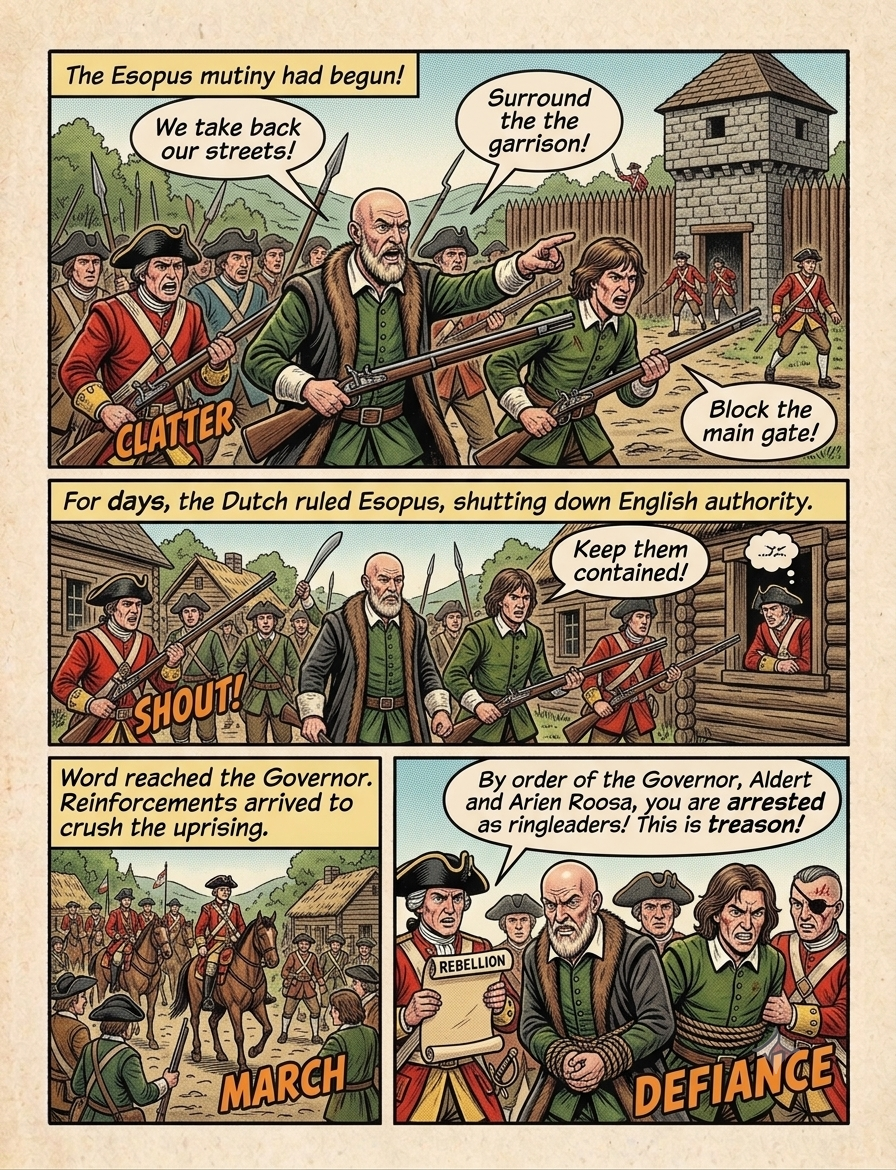
Aldert and Arien Roosa were at the very front of the storm. Alongside their neighbors, they took up arms, surrounded the garrison, and effectively shut down English authority in the settlement. For days, armed burghers patrolled the streets, defying the crown and forcing the garrison to retreat behind their quarters.
When word of the uprising reached the colonial governor in New York, the hammer came down hard. Reinforcements marched on Esopus, crushing the rebellion. Aldert and Arien were arrested and dragged before a military tribunal, branded as ringleaders and instigators of treason.
The verdict was swift and merciless: total banishment from the colony. For a family that had built their life out of the wilderness, losing their land and being cast into the wilderness was a death sentence.
Yet, the Roosas were not so easily broken. Even in defeat, the sheer scale of the Esopus uprising forced the higher authorities in New York to realize that brutal military tyranny would only destroy the lucrative colony. Desperate to stabilize the region and reintegrate the proud Dutch population, the governor was eventually forced to soften his stance.
Months later, the heavy sentences were reversed. Aldert and Arien returned to their lands, bruised by the empire, but standing tall on the soil they had fought so fiercely to hold.


Comments