Grandpa Ed's Journey (1887 - 1973)

The Quiet Man
At the dawn of the 20th century, the American cultural landscape was dominated by the mythology of Horatio Alger—tales of gritty boys heading west to find fortune through sheer "luck and pluck." My grandfather, Edward, was a notoriously quiet, slow-moving man from New York. But by 1921, at the age of 37, he was still single, living with his younger brother, and restless for a change.
Inspired by the real-life success of William B. Brown, a New Yorker who had moved to Michigan and built a massive floral empire, Edward finally made his move. He boarded a New York Central train to Detroit, likely marveling at the opulence of the rail cars while stubbornly refusing to pay for a meal in the dining car.

In Detroit, Edward’s strict work ethic quickly made him a foreman at the Brown Florist Company. The job brought him more than financial stability; through a coworker, he met Lottie Ware. They were married on August 3, 1921, triggering an unprecedented whirlwind of change for a man who usually took years to make a decision.
The Stone House in Metamora
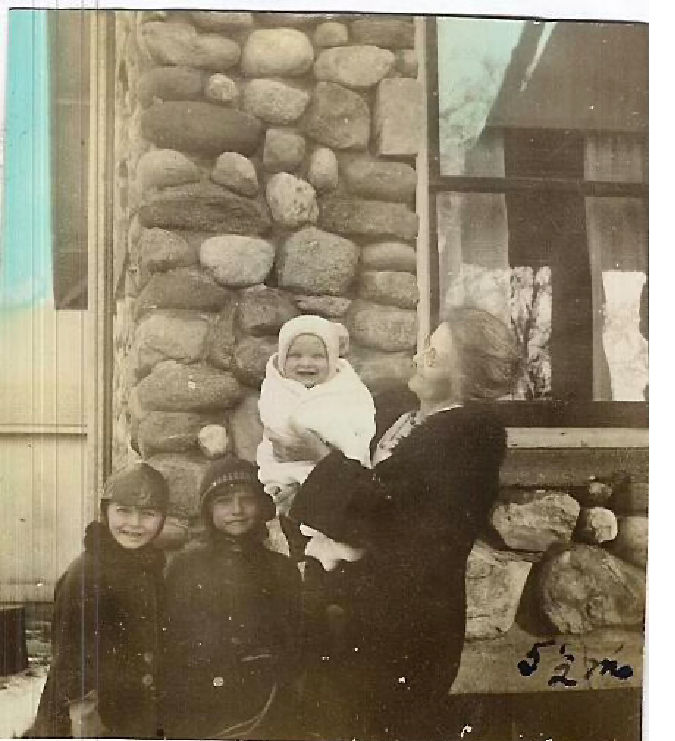
By the mid-1920s, Edward and Lottie had two children, Ruth and Robert. Despite his success in the city, Edward grew anxious about raising a family in Detroit. He yearned for wide-open spaces, leading him to buy a farm with a quaint stone house in Metamora, Michigan.
Metamora was a land of contrasts. It was a rustic village surrounded by the lavish weekend estates of wealthy Detroit executives who hosted formal fox hunts. Edward ignored the high society around him, focusing instead on his sheep, his crops, and his family. In 1930, their third child, my father Roger, was born. True to Edward’s lifelong passion, the very first discipline recorded in Roger’s baby book was a simple command: "To respect plants."
For a few years, life in the stone house was an agrarian idyll. Edward spent his days in bib overalls and a straw hat, quietly tending to his pastures. Even his former employer, the wealthy Mr. Brown, would occasionally drive out from the city just to seek the counsel and grounding presence of his fiercely loyal former foreman.
Tragedy on Barber Road
The idyllic scene shattered on Mother’s Day in May of 1938.
Following their strict 4:00 AM routine, the family had finished their morning chores and was preparing for church. Edward’s twelve-year-old son, Bob, was riding his bicycle down Barber Road, a quiet gravel stretch near the farm.
Edward looked out and witnessed the horror firsthand: an out-of-control car, driven by a neighbor, struck Bob. Inside the house, eight-year-old Roger was playfully waiting behind a door to jump out and scare his father. But when Edward walked through the door, he was deathly pale.
"It's Bob," Edward announced in shock. "He's been hit by a car."
Bob never recovered, and in truth, neither did his parents. Though they lived in the stone house for twelve more years, a shadow of grief permanently settled over the family.
The Long Shadow
As the years rolled on, age caught up with Edward. To pay the bills, he was forced to sell off pieces of the farm, eventually selling the house and barn around 1950.
Unwilling to simply sit in a rocking chair and waste away, a 65-year-old Edward moved Lottie to a tiny two-story home in Ortonville and took a job as an elementary school janitor. He worked there for a decade until the board replaced him with a younger man. Refusing to quit, he crossed the street and spent another ten years working as the janitor for the local Baptist church.
By the time I entered the world, my grandparents were elderly, cloaked in a heavy, impenetrable fog of sorrow. They were simple people who understood flowers, livestock, and hard work, but felt entirely alienated by the rapidly changing modern culture around them.

Edward passed away in May of 1973. He was laid to rest next to young Bob in the Metamora Cemetery. It was the first funeral I ever attended, and to this day, the scent of roses brings me right back to the quiet, grieving man who spent his life chasing his own version of luck and pluck.


Comments