The Breath of God in Rose Family History

An Introduction to Rose Family “Bibliology”
My Fond Memory
When I was a young boy, an announced visit to my Grandpa Ed’s little house in Ortonville, Michigan was usually met with grumpy groans. There were many reasons I do not plan to share here. However, there was something in their front room (what we now call a living room) that managed to capture some boyhood imagination. They had a large oak table on a wall containing a lamp and an old, leather-bound book: the Rose Family Bible. We had many Bibles in our house so that was nothing unusual. However, this one was different: it was big, it was obviously old (with a fragile leather binding someone had tried to tape together), and, most memorable to the little boy was how it smelled! Like a musty old basement.
I am pretty sure I tried to open it and look inside at some point. I am also fairly certain I was given a stern warning not to do it (Grandma and Grandpa were always afraid we would break something). At some point, someone (I’m not sure who) took the time to guide me in a brief peek. I know because, 40 years later when I inherited the Family Bible and began a more leisurely examination, the old memories of particular pages came rushing blacke–especially the center pages where births, deaths and marriages of the family were chronicled–inlcuding my own in the birth’s section, written in Grandma’s shaky handwriting: James Edward Rose, born April 25, 1957,
From that time forward the Rose Family Bible captured my imagination. I began to appreciate its value, especially those center pages, chronicling family history from the first entry of Philip B. Rose, in 1832.
My fascination with family history developed into a passion (at times bordering on obsession).
When studying the longer ancestral tree I learned that before there was a Rose Family Bible, there was a Roosa Family Bible. It was not an English Bible like mine but Dutch and by all accounts was purchased by my Palatine ancestor, Aldert Heymans Roosa around 1630 just prior to his immigration to America.
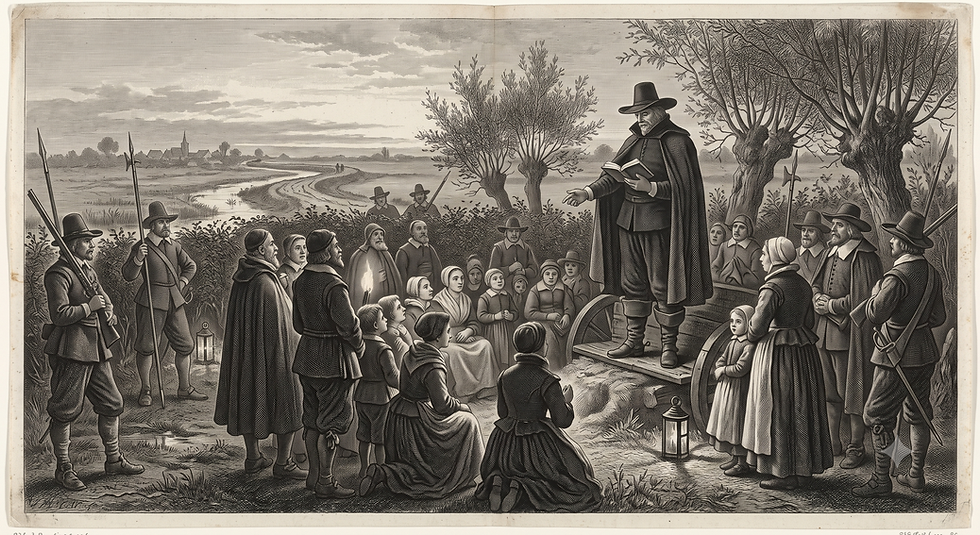
But, what did the ancestors before Aldert do–before 1640? That opened another window of curiosity and research and it is where this chronicle begins: in the “front room” of Goert Rosa’s modest home in Herwijnen Netherlands, around 1560. History doesn’t tell us Goert’s story. But it has much to say about God’s breath in the generations before.
The Breath of God in Creation
From the moment of creation, the Holy Spirit—the third person of the Trinity—was actively present. While we can easily gloss over it in the opening verses of Genesis, the text is explicit: “the Spirit of God was hovering over the face of the waters” (Genesis 1:2). Ephesians expands our understanding of this trinitarian economy, revealing the Holy Spirit as the "pledge" or "seal" (Ephesians 1:13-14) who applies the sovereign will of God the Father and witnesses to the finished redemption of God the Son.
In the execution of God's plan, the Holy Spirit acts as the primary agent of what is called “special revelation”—God’s supernatural manifestation of Himself to His creatures. To use a helpful linguistic analogy: God the Father is the absolute Speaker, God the Son is the Speech-Content, and the Holy Spirit is the Breath that carries the divine message throughout creation. In human interaction, speech requires breath; without the breath from our lungs, words cannot be projected. Similarly, we could have no saving knowledge of God’s will and works without the witness of the breath of the Holy Spirit. Simply put, we would have no Scripture without the Holy Spirit.
Theologians categorize this study under the broad heading, Bibliology (the doctrine of Scripture). When isolating the Holy Spirit’s specific role in producing the text, we call it the doctrine of inspiration. This stems directly from a verse in 2 Timothy 3:16, where Paul uses the Greek word theopneustos, which literally translates to “God-breathed.”
It is one thing to harbor fond memories of an old Rose Family Bible resting in a grandparent’s front room. But to appreciate its eternal significance requires a deeper understanding of that book as a historical witness to the breath of God. The doctrine of organic inspiration explains how a physical book on a table can faithfully convey the living voice of the Almighty, and how the Holy Spirit uses those words to radically transform the lives of the readers.
Historically, the church has rejected mechanical dictation—the false view that God merely treated human authors like passive secretaries typing out a boss's letter. If inspiration were merely mechanical, the unique personalities, vocabularies, and struggles of Moses or Paul would be irrelevant, and the active, organic work of the Holy Spirit would be unnecessary.
Instead, Reformed theology affirms organic inspiration. Just as human speech requires a speaker, speech-content, and breath, the Scriptures came to exist because God the Father spoke in history, God the Son perfectly embodied that word, and God the Spirit mysteriously moved in the hearts, minds, and distinct personalities of human authors to record these truths without error.
While the historical accounts of my Rose ancestors in this chronicle are dramatized, the theological reality is not. The primary objective of this history is not to exalt my ancestors, but to highlight the Word of God that sat in their homes. In that sense, this narrative is entirely true. The true "main character" of this history is the Holy Spirit of God, who breathed out His infallible Word, and the generations of the Rose family who took the time to listen to Him.
Comments