The Breath of God in Rose Family History (1560)
- revjerose
- Jul 16
- 11 min read
The Breath of God for Goert de Rosa (1560)
Historical Note: As dramatized in another chronicle on Goert de Rosa, a fictionalized pirate story during the Spanish Inquisition, I’ve speculated that this first known ancestor in the Netherlands had roots in Spain. The reason for that story was to account for the old family legends about the origin of the first Roses–Rosas Spain on the Catalonian coast.
Most careful genealogists today reject the Spanish origin story (not to mention the amazing claim that they were Jewish). But I wrote that story to suggest how both could be true even how he might have become a protestant Christian.
If Goert did indeed profess the Christian faith (and his children and grandchildren certainly did) how did that happen? How did he become a Protestant rather than a Catholic? Readers may recall what was taking place throughout Europe during these tumultuous times.
One of the first “Protestants” was William Tyndale in England. In 1536 he would be burned at the stake as a heretic. Over in Germany, Martin Luther had nailed his 95 “theses” (truths) of protest against the Catholic Church on the doors of Wittenberg Cathedral. And also in this generation, John Calvin would begin writing his masterpiece of Protestant theology: The Institutes of the Christian Religion.
Shortly after this, Lutheran missionaries from Germany heard the call of God to take the truth into the low country we call the Netherlands. It was under Spanish rule then. King Philip was fiercely anti-protestant and took out his fury on any attempts to bring the Bible to the people. The history of persecution and resistance is beyond the purpose of this chronicle. But how that larger history touched the life of my ancestor, Goert de Rosa around 1560 is the story, specifically, how the Breath of God in the Bible changed his life.
The White Swan Tavern, Herwijnen, August 1560
Goert de Rosa sat in the White Swan Tavern in the heat of August drinking a pint of dark ale.
Taverns were the center of rural village life. Men would go there daily, often in the evening after work, to laugh, play cards and discuss the news of the day.
Goert was not listening to the chatter tonight. A few years ago he would have been the most boisterous voice in the hall. He would have been the winner of every card game. Lately, he could hardly smile. He went to drown his sorrows.
He had married Marie around 1540. That event was a big reason for the changes that were shaking his world. Even more than that, was the birth of his two children–son Gijsbert and daughter Clare.
He had never been a man to spend much time in deep thought. He had definitely not been one to contemplate religion. But recently he could not stop thinking. He often spent long moments staring into the distance, his thoughts churning in his mind. At times his imagination conjured up the faces of Gijsbert or Clare. He would even be overcome with emotions he found unbearable: episodes of crushing guilt weighed heavily. He had never been a man to regret the past or worry about what others thought of him. But his children changed all that. What if Gijsbert one day learned stories of his father’s past? When Clare was grown, what would she think of her father’s youth? There were things he had never told a soul. He had imagined such stories could be locked away in some dark corner of memory. But what if they couldn’t?
Goert snapped back into the moment as he was startled by the thud of a tankard on the table. A heavy set man was pulling up a wooden chair. He plopped down next to Goert with a groan. It was his neighbor, Arien Meerten
“Goert! Your face is so long I might have tripped over it! Goert was not amused or ready to share the good humor of his friend. In Dutch he said,
"Ic quam om wat lichts te bringhene." (“I came to bring some light into your darkness”).
Goert was struck by the phrase, “bring some light.” It was obvious enough but it stirred something deep inside him he could not understand.
After a furtive look in all directions, Meerten’s jovial mood changed.
He leaned close toward Goert’s ear. “I want to invite you to my farm for a visit. I have some “light” to share.”
Once again, the way Meerten spoke touched chords in his heart he could not figure out.
Goert was annoyed at the mystery but it also made him curious. “When?” he asked.
Arien Meerten looked around once again. He whispered so low Goert had to read the man’s lips “We meet just after dawn in the meadow.”
Against his better judgment, Goert found himself nodding in agreement. He didn’t know why, but he could hardly say no.
The Meerten Meadow, Sunrise
The next morning, Goert made his way under the cover of darkness to the Meerten Meadow. He could not imagine what was so important. If he would have considered it more he might have stayed in bed. But it was almost as if he had no choice.
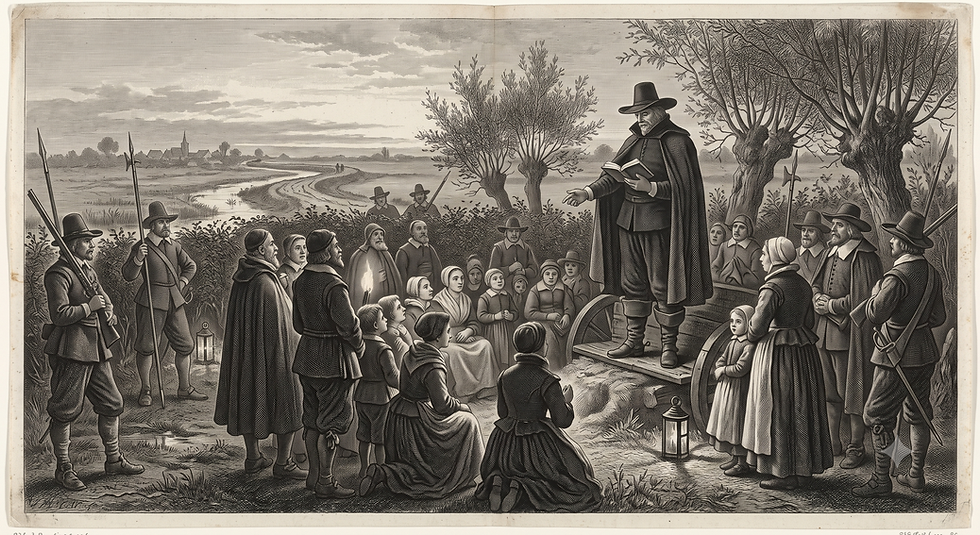
At most, Goert suspected the meeting had something to do with the political unrest. Herwijnen had been under Spanish rule since before Goert’s birth. Charles V of Spain was one of Europe's most powerful monarchs. He had recently handed the throne to his heir, Philip II. This cruel despot would prove to be one of the most tyrannical in his generation. As he walked Goert figured this meeting was another protest of the outrageous taxes levied on the farmers of Gelderland Province.
When Goert arrived, the first lights of morning were visible on the horizon, now casting shadows. Goert expected to see other neighbors. But he did not expect to see dozens of men perched on horses, holding speers, pike and a few matchlock rifles. They formed a perimeter around an open space where a few dozen village men had gathered.. Most of them Goert recognized.
He also recognized Arien, standing in the center of the clearing. He was talking to a man Goert did not recognize.
The real name of the stranger would not be spoken but he routinely traveled under a false name: Jerome.
He wore the clothing of an ordinary traveler: a dark, heavy wool doublet, breeches, thick leather boots and a wide-brimmed hat, He was a very tall man, towering above Goert’s squat overweight friend.
Meerten faced the gathering and spoke,
Mijn vrienden ende geburen, ik heet u dezen morgen welkom. Het is ons een vreugd dat wij een bezant bezoek ontvangen van een bezonderen gast. Voor zijn eigen veiligheid zal ik hem alleenlijk 'Jerome' noemen."
“My friends and neighbors, I welcome you this morning. We are pleased to have a visit from a special guest. For his safety I will only call him “Jerome.”
Goert was even more perplexed as this “Jerome” began to speak. He spoke Dutch words but not as a Dutchman.
He was even more surprised with the words coming from the stranger’s mouth. It was not the fiery political protest he had expected, railing on the Spanish king for unfair taxation without representation. He did use terms like “bondage” and “slavery” but not in the context of taxes and political oppression. He talked about the bondage of the will that kept men in the slavery to sin.
Goert did not realize that the black clothed speaker was Guy de Bres, one of the earliest Protestant missionaries to the Netherlands. Trained by the Genevan Reformer John Calvin, de Bres was one of the authors of the recently published Belgic Confession.
Church history would bear out the importance of this confession as one of the most important theological confessions of the Protestant Reformation. Of course, Goert had no idea about any of that history but he would forever remember a few words from Jerome, not coincidentally, citations from the Belgic Confession, published in 1561::
We... rest on the only obedience of Jesus Christ crucified; His obedience is ours when we believe in Him. This is sufficient to cover all our iniquities and to give us confidence in drawing near to God, freeing our conscience of fear, terror, and dread..." (Article 23)
Hearing the words, “fear, terror and dread” pierced Goert’s heart like a knife lancing a boil. For the first time in months–perhaps his whole life–Goert imagined there could be light in his darkness. Fear, terror and dread had followed hard after him especially in recent days. Though he had no formal education Goert was not an ignorant man. So, when the man said, “we rest on the only obedience of Jesus Chrsit crucified” he had enough knowledge to understand what he needed most to hear. Even in the Catholic mass of his childhood he heard the name of Jesus Christ. Even in the Latin of the mass that name was unmistakable.
But now, in this moment, in his own tongue, Goert heard the “good news” of Jesus’ obedience. In the preacher’s words, Jesus’ obedience was “sufficient to cover all his sins.” The promise of a conscience free of fear, terror and dread flooded his cryiing heart like no words he had ever heard before.
Goert’s Dinner Table (1566)
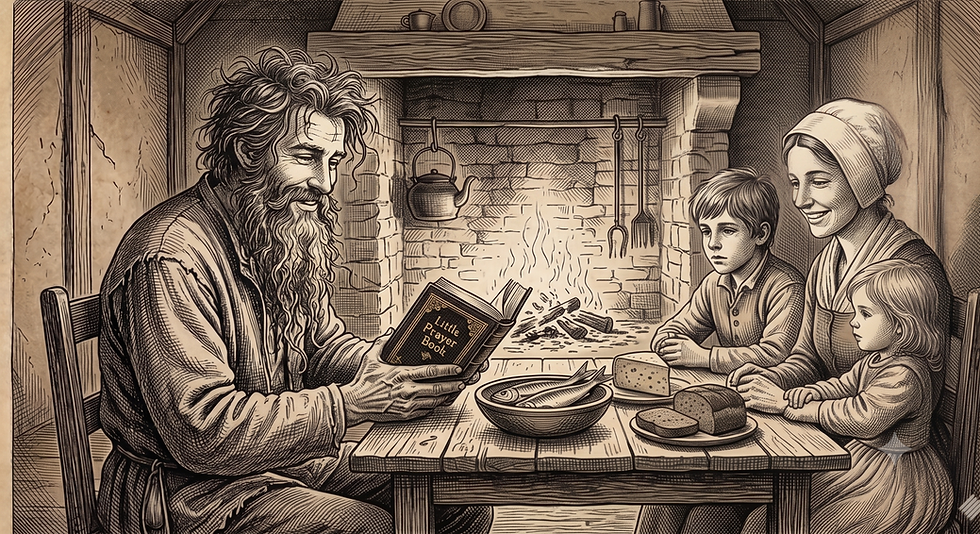
Goert sat at the head of the wooden trestle table in his modest country home. A crackling fire blazed in the hearth. Around him sat his wife, Marie, and their two children, Gijsbert and Clara. In the center of the table sat a modest meal of brown rye bread, a small wedge of hard cheese, and a bowl of salted herring. But next to the bread lay the family’s greatest treasure: a small book.
Much had changed in Goert’s life since that morning in Meerten’s meadow years before. Political events in the low countries of the Gelderland Province of Herwijnen were increasingly chaotic and always the talk in the White Swan and in the marketplace. But it was the message of “Brother Jerome” that remained in the forefront of Goert’s mind. He had, in that moment, heard the “good news” of the Gospel for the first time. He not only heard it with his ears but with the inner ear of the soul. Goert came to the Meerten Meadow as a man dead in his trespasses and sins. He left a new man; not perfect by any means, but free from the fears, terrors and dread that had enslaved him all his life.
When he told Marie what had happened in the meadow that morning, she was not surprised at all. She smiled with tears on her cheeks as if she already knew. Together, they determined that their children would hear this good news every day of their lives.
Marie was actually the first to hear about a small book called, Souterliedekens. It was a Dutch word that meant “Little Psalm Songs.” Her friend and neighbor, Wymtje Meerten had shown Marie their copy and explained how it contained Bible passages put to music. Every night, after the evening meal, the Meerten family selected one to sing together.
Marie determined to somehow secure one of these for their family.
Though the fiery preachers like de Bres were the recognized heroes of the reformation, there were unsung heroes as well: the foot soldiers of men like de Bres. Long after he had moved on to another village, a particular category of these foot soldiers called colporteurs conducted high risk operations in Herwijnen. In our dramatized history, Marie was the one who made the first contact with a colporteur.
For all the appearance, the man in the wooden horsedrawn wagon coming across the de Rosa field one morning looked to be a simple peddler. They were a common sight in the rural countryside, their wagons filled with pots and pans, bags of seed grain, sometimes bolts of cloth. They were traveling “salesmen” making their living on the old dusty paths.
When she saw him coming she made a mental inventory of her kitchen. Money was scarce but her family needed to eat. Fortunately for her, they were still well-supplied and she planned to politely send the man on his way. Marie stood waiting by the front door as he approached.
The man stood at a respectful distance, removed his hat and spoke,
"God groet u, goede vrouw." (God greet you, good woman.)
Marie replied in the normal way to a stranger,
"Goeden dag en vrede zij u."(Good day and peace be to you.)
Marie expected the customary banter about his wares but was surprised when instead he said,
"Ik breng de klare waarheid voor uw huishouden." (I bring the clear/unmixed truth for your household.)
Marie immediately knew this was no normal peddler. As she and Goert had spent time over the past few years with other protestant neighbors they had heard the word de klare to describe a particular portion of the Bible. This was the most risky part of the colporteur’s business. Like spies in a secret meeting, it was a codeword to distinguish friends and foes.
Marie hesitated. She too had to be careful. Stories of women being trapped by a spy abounded. Though Protestant men might be captured and hanged, women were secretly buried alive.
Marie whispered a brief prayer for God’s help, glancing back in the house to see her children. She recalled the story from her neighbor telling of an encounter with a missionary peddler. Wyntje Meerten had spoken this in response:
"Wie de stem van de Herder hoort, zal niet dwalen." (He who hears the voice of the Shepherd shall not wander.)
Immediately, a bright smile broke on his face, including a sigh of relief. Both knew they could trust the other. With quick eager steps, he excused himself as he returned to his wagon, rummaged around in a wooden box and found what he was looking for: a small leather bound book.
Marie was filled with joyful anticipation. She could see what he held. It was the answer to her prayers.
The book was bound in a thin sheet of pigskin leather. Though the cover was stamped with the words, Een Schoon Liedekens-Boeck" (A Beautiful Little Songbook): Marie knew that was a ruse to shield its actual contents from the wrong eyes. Its pages contained printed psalms from the Bible, along with musical notations. Personal copies of the entire Bible for common people like Roosas would not be available for a hundred years. .
Pleasant memories of the little book warmed Marie’s heart as Goert spoke:
"We zingen raddelijk, en dan eten we." (Literally: "We sing quickly, and then eat we.")
Gijsbert obediently and respectfully handed the psalter hymnal to his father. The book was already showing signs of use. In addition to the smudges on the cover, the pages were becoming dog-eared.
On the inside cover, Goert had begun writing notes and making entries of importance for the future. When he had gotten it four years before (the only printed book he ever owned) he marked the event by writing his family name on the inside front cover. Later, he decided to add the other names and birthdates of the family, as well as the date he and Marie made their marriage banns.
Goert spoke again. This time it was more whispered. Uttering the next words was considered treason and heresy and could mean death. He looked down at the psalm marked for today: Psalm 8. Above a musical notation, the Dutch text read:
Ghesonghen op de voise: 'Ick ginck gisteravont ter herberghen in...'
"Sung to the tune of: 'I entered into a garden green...'"
Goert gave a low, humming pitch. Together, in a soft, hushed unison, the family began to sing the words from Psalm 8:
O HEERE, onze Heere! hoe heerlijk is Uw Naam op de ganse aarde!"
"O Lord, our Lord, how excellent is Thy name in all the earth..."
Baby Clara smiled to the familiar, bouncy rhythm. She could not have known what was taking place inside her as the tune and words were effortlessly mapping the “breath of God” on her heart and mind. For Gijsbert, the power of the Breath was even more extraordinary and even before he embraced the eternal significance, this “covenant privilege” would shape his desires and beliefs about himself and the world.
Even as they sang, Goert kept an eye on the door. Their song barely rose above the crackle of the hearth. As the final note faded into the quiet room, Goert closed the book.
He picked up a small piece of charcoal from the edge of the hearth and carefully made a small tick in the margin of Psalm 8. He glanced briefly at the next page and the notation, Psalm 9. He felt a special satisfaction knowing that this spiritual path was the right one for him and his family.
"And now we eat,” Goert said . “God has preserved His covenant to us this day,"
Breaking the brown bread before them with his hands he handed a portion to Marie. Then to Gijsbert and Clare. "Let us eat our daily bread with thankful hearts."
The meal was simple, but the room felt warm not just with the wood of the hearth but more so by the words of life they had shared together. God was breathing on Goert, Marie, Gijsbert and Clare. The breath originated with God the Father in heaven. Contained the word of God the Son, and was carried to Goert’s family on the wings of a common street song.


Comments