The Breath of God for Aldert Roosa (1659) by J.E. Rose

Historical Note:
The "Dutch Puritan" movement was properly called “the Nadere Reformatie” (or Further Reformation). It emerged in the 17th-century Netherlands as a response to what was perceived as a stalled, overly institutionalized Protestantism. It was during this time that the Latin phrase “semper reformanda” (always reforming) became a watch cry for the most passionate churches.
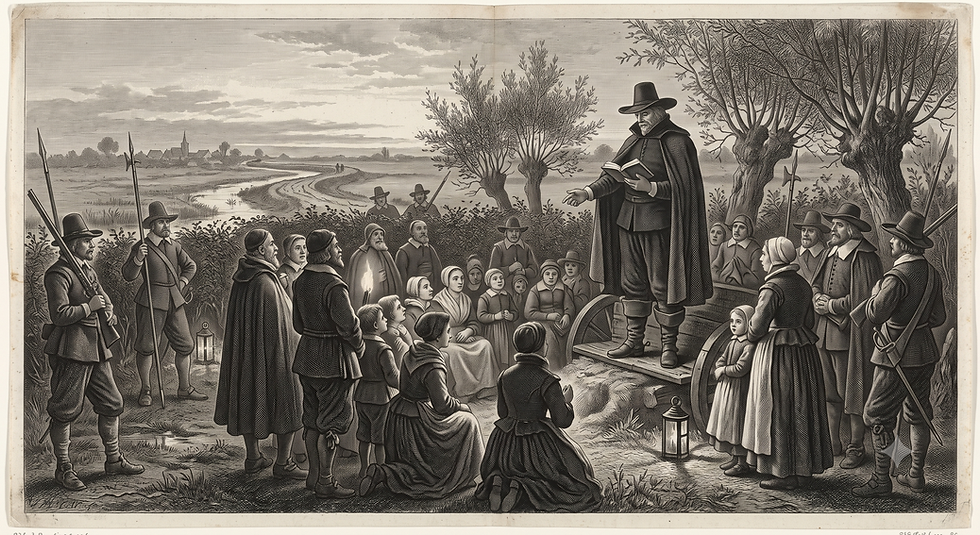
Influenced deeply by similar impulses in English Puritanism, leading Dutch theologians like Gisbertus Voetius argued that the initial Reformation of doctrine, while essential, had failed to bring about the necessary inner transformation. One of his students, Jacobus Koelman, took that message into the congregations with his fiery and controversial sermons.
Koelman championed a faith marked by rigorous personal piety, strict adherence to the Synod of Dort, and the "priesthood of all believers." He particularly emphasized the vital spiritual governance of the family, viewing the huisvader, (or head of the household), as a "family prophet" with a sacred duty to ensure the salvation of his household through pure worship and the definitive study of the Scriptures.
Though there is no historical document connecting Aldert Roosa to this movement, there are plausible reasons to think it impacted him, particularly how he viewed himself as father, wealthy landowner, and an important officer in the church.
For an affluent patriarch and pillar of the established Dutch Reformed consistory like Aldert Heymans Roosa, this theology offered a profound, transformative framework for interpreting his life’s mission.
The movement’s core concept of "ecclesiastical precision" and its implicit "New Israel" typology presented the world not just as a place of economic opportunity, but as a spiritual battlefield. Hearing these ideals, potentially firsthand from Koelman or his disciples in Utrecht, likely changed Aldert’s perspective from a commercial agriculturist managing an saturation-point estate to a "Covenantal leader" called to plant a "true vineyard" in a clean soil.
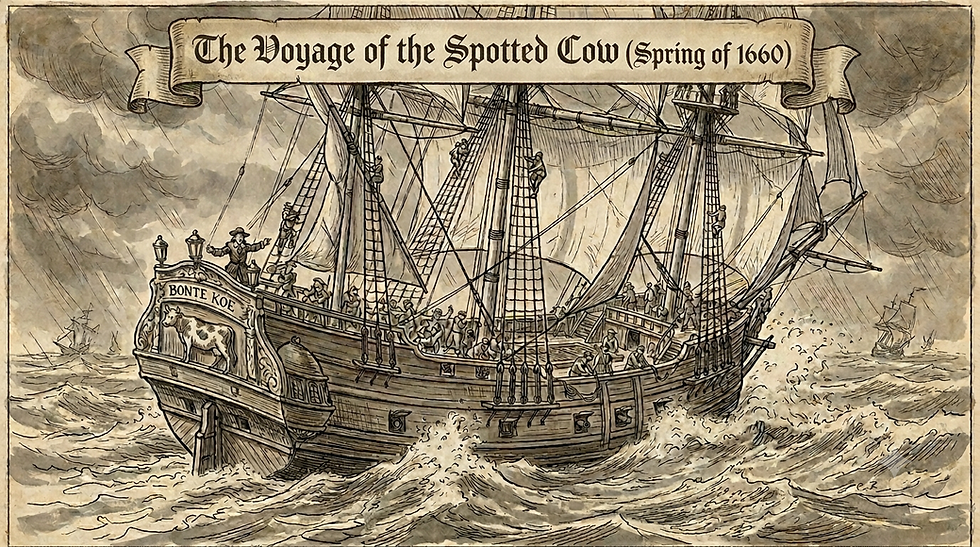
When Aldert made the colossal investment to purchase the expensive Statenbijbel for his eight sons and led his massive family on a difficult transatlantic voyage to New Netherland, he was arguably executing a final act of Koelman-like obedience, seeking a wilderness sanctuary where his household could live under God’s complete authority, unhindered by the social and political compromises of the Old World.
We sometimes talk about being a “fly on the wall” during important events in history. What would that have been like in a consistory meeting of the Herwijnen Dutch Reformed Church officials? In this dramatization I try to suggest how Alder’s decision to take his family and settle in the New World was not just about personal enrichment, but a step of faithful obedience. We know from documented history that this Family Bible made the voyage to the New World. The Bible still exists in the possessioin of Roosa family descendants. Perhaps this is how Aldert acquired it and why.
HERWIJNEN REFORMED CHURCH - CONSISTORY ROOM - NIGHT 1659
A heavy oak table anchors the center of the cramped, stone-walled room. A solitary iron candelabra flickers, casting long shadows against white-washed walls. Outside, a relentless Gelderland rain lashes against the leaded glass windows.
Six men sit around the table, wrapped in heavy, dark wool cloaks. These are the ELDERS and DEACONS of the Herwijnen Reformed Church.
At the head sits DOMINE VAN DYCK a man in his 60s, weary, cautious, with a soft face lined by decades of world experience.
To his right stands ALDERT HEYMANS ROOSA. He is imposing, bald-headed, with a thick, sharp beard. His eyes burn with the absolute, uncompromising conviction of a convert. No one at the table is ignorant of his influence in the church and community. When he speaks others listen.
In an unusual turn of events, Aldert has brought something to this meeting: a massive, freshly bound volume of the official Dutch translation of the Holy Bible, It is called the STATENBIJBEL (State Bible). Its heavy brass clasps catch the candlelight. Aldert frequently, unconsciously touches the book. He recently purchased it at great cost during a trip to Utrecht.
Owning such a rare jewel has emboldened his faith even more. That is evident in his demeanor this night, even more intense than usual. Aldert is talking about the “wilderness” in the New World and his growing conviction that God is preparing to do a mighty work to build a New Jerusalem.
ELDER DIRK (50s), a weathered, prosperous tenant farmer, leans forward, tapping his pipe against the wood.
ELDR DIRK You speak of a wilderness, Aldert. You speak as if the Lord’s arm is too short to reach us in Gelderland. We have peace. The Spanish are gone. The harvest is being gathered into the barns.
ALDERT (Voice tight, controlled) Peace? You mistake the absence of war for the presence of God, Dirk. Look around you. The magistrates in Amsterdam open the gates to the Remonstrant heretics for the sake of their coin. The Papists still celebrate their mass in secret while the consistory looks away. We have reformed our doctrine, yes—but we have failed to reform our lives!
DOMINE VAN DYCK (Gently) The Church must be a sanctuary, Aldert, not a furnace. We endure the frailties of the State so that we might preach the Word in safety.
ALDERT (Striking the top of the Statenbijbel) No! The Word demands precision, Domine!
Last winter, my son Arien and I were on business in Utrecht. We were able to attend the Buurkerk Church where we heard the young divine, Jacobus Koelman.
His tone became more pleading and less strident for a moment as the memory of that event played in his mind.
He spoke that morning of the vineyard of the Lord. He asked us: Will you let the walls be broken down by compromise? Will you let the wild boar waste the pleasant plant?
DEACON CORNELIS a nervous, younger man, shifts in his seat.
DEACON CORNELIS Koelman is a radical, Aldert. A university professor can breathe fire, but we live in the lowlands. We have families to feed!
ALDERT And it is for my family that I speak, Young Man! I have eight children under my roof. If I raise them here, in this lukewarm mud, what becomes of them? The land is choked. They will be forced into the cities to buy and sell with heretics, or become tenants to men who care nothing for the Synods of Dort. I want more for my children and grandchildren.
ELDER DIRK So you will throw them into the ocean? You will drag your wife and a nursing infant onto a timber ship to cross a savage sea? For what? An idea?
ALDERT For a mission!! That’s not just an idea! Domine Koelman opened the scriptures of Exodus. He showed us that New Netherland is not a mere trading post for the West India Company. It is a new wilderness God has swept clean for His true people to inhabit. A New Israel! A New Promised Land.
Aldert leans over the table, his face inches from Domine Van Dyck.
ALDERT Across the sea, there are no worldly magistrates to tell us who may sit at the Lord’s Table. There are no compromises with the Synods. We can build the vineyard walls of Jerusalem so high that no corruption can breach them.
DOMINE VAN DYCK (Softly, sadly) You want a pure church, Aldert. So do we all. But consider, my Friend, the Lord’s net catches both good fish and bad. You cannot build a perfect world on this side of eternity.
ALDERT But I can obey the call to try! Look at this book.
Aldert lifts the heavy Statenbijbel, holding it like a shield in front of his chest.
ALDERT This Bible cost me weeks of labor. I did not buy it to sit on a shelf while my homeland rots. I bought it as a blueprint for God’s mission. If the old house is decayed, the builder must take his tools and find new ground.

ELDER DIRK The consistory will not support a mass departure, Aldert. We will not advise the flock to abandon their callings in Herwijnen. The work of this vineyard is important to God as well.
ALDERT (Drawing himself up to his full height) Then the flock will divide. I am not asking for your permission. I do ask for your blessing.
Aldert hooks his fingers into the brass clasps of the Bible. He clutches it like a soldier his sword. He surveys the faces of his brethren, looking for their favor. One by one, they refuse his gaze, looking down at their hands on the table. They are as resolved in their opposition as Aldert in his determination.
ALDERT With a quiet sadness in his voice,
My family will sail. We will take the pure Word, and we will plant God’s vineyard in the New World.
Aldert turns on his heel and exits the room without looking back. His heavy leather boots echo against the stone floor as he strides out, leaving the others sitting in stunned silence as the candlelight of Herwijnen flickers dimly.

Comments