The Voyage of the Spotted Cow (1660)
Historical Note:
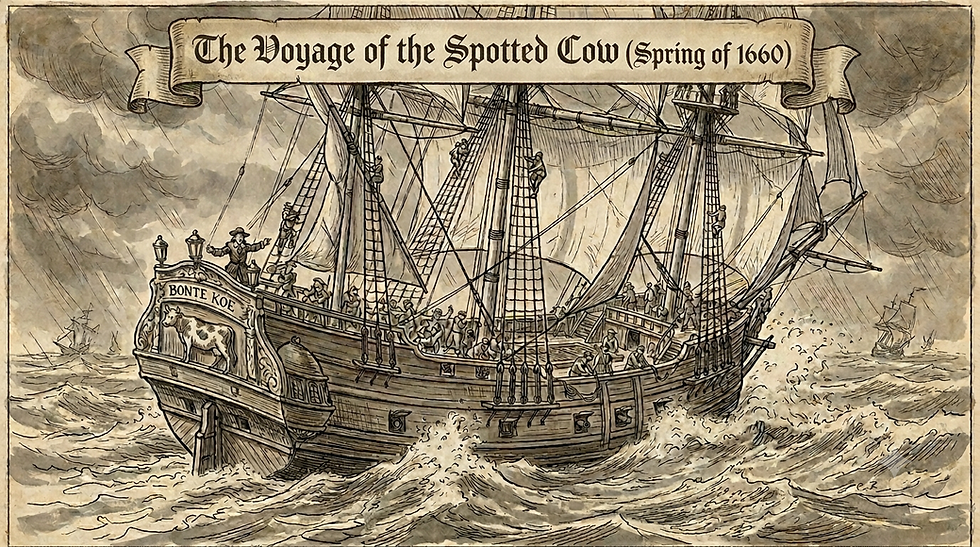
The record of Aldert’s journey to the New World aboard the Dutch ship. Bonte Koe (spotted cow) is well-documented in multiple ways, including the ship’s log of its captain, Pieter Lucasz. The Bonte Koe was one of the fleet traders of the powerful West Indian Company (WIC) whose influence during that era is much overlooked. Very few passengers would have the financial resources to pay upfront. Consequently, the WIC had a mutually beneficial solution: passage in exchange for months to years of indentured servitude to the WIC.
As a wealthy farmer, the Roosas did not require such an arrangement. This no doubt also made them notable to Captain Pieter and could have inspired some of his curiosity in the logs.
Thanks to the extensive record keeping of the Dutch Immigration Society, we know quite a bit about the ship itself and the other passengers during that voyage. For example, a young Dutch soldier, Pieter Peterzen, and his family. Peterzen and 17 other soldiers were sent to provide security and protection for the settlers. Troubles with the native population were worsening. Within a few years they would boil over and men like Pieter would be the first line of defense.
Though ship’s logs would not normally contain fine details about the passengers and their personal lives, the premise of this dramatization is that Captain Pieter had become lonely and isolated over his years. Watching Alder’s family–not to mention Alder’s attractive wife–reminded him of what he never had.
The Log of Captain Pieter Lucasz
On Board the West India Company Ship De Bonte Koe
En Route from Amsterdam to New Amsterdam, Spring 1660
Log Entry: April 18, 1660
Position: North Sea, clearing the English Channel. Winds blowing steady from the northeast.
Log Note: Held review of the passenger manifest this morning. The holds are packed tight
with standard WIC cargo—farm implements, gunpowder, scrap iron, and horse saddles—but the real cargo is the souls. Seventy-odd passengers are packed below.
Among them is the family of Aldert Heymans Roosa, a wealthy agriculturist from Herwijnen in Gelderland. A man of formidable posture, he does not carry himself like the destitute laborers we so often ferry. He paid the passage in full for himself, his wife Wyntje Ariens de Jongh, and their eight children. Eight of them! From Arie, a grown lad of seventeen, down to little Aert, who has seen but two winters.
My chief mate expresses concern over the space they occupy, but Roosa is civilized and brings substantial property. It is rare a family of ten pays full price for the voyage up front! If he handles a plow as firmly as he handles his boys, New Netherland will gain a fine burgher.

Log Entry: May 12, 1660
Position: The Mid-Atlantic. Heavy swells, gray skies.
Log Note: A fierce gale has kept the passengers battened down in the dark of the 'tween-decks for three nights now. The stench of bilges, wet wool, and seasickness is thick.
I went below to inspect the structural timbers and found the Roosa family in a tight cluster. The wife, named Wyntje, is a woman of remarkable grit. I watched as she calmly distributed hardtack to her middle children even while the ship pitched violently. She never lost her footing or her temper.
She possesses a striking countenance that the grim dimness of the hold cannot obscure. There is a quiet grace in her expressions and her movements that could catch a lonely captain’s eye. Though one looks away out of respect, yet the memory lingers, only heightened as each day passes.
The husband, Alder Roosa, seems to be a force of nature. He was in such a heated exchange with another passenger over some detail of Dutch theology that I thought they would come to blows. What a sharp tongue he has! Clearly, he does not tolerate weakness or dissent. And from what I can tell, his eldest sons look upon their father with a mix of awe and fear. This family will either be the bedrock of a new town or a thorn in the side. .
Log Entry: June 2, 1660
Position: Approaching the Western Atlantic. Fair winds, clearing weather.
(Visualizing the Atlantic horizon after weeks of storm—clear skies at last.)
Log Note: Allowed the families on deck to dry their bedding and breathe the salt air. The Bonte Koe looks like a floating textile market. Women have spread their linens and family clothing like draperies on every shroud and rail.
Kept a close eye on the Roosa clan today. Their four-year-old was nearly knocked off her feet by a swinging block and tackle. At the last moment, an alert older sister caught her. Meanwhile the father stood by the mainmast, deep in dispute with other men about the new land.
He possesses a literate mind. I observed him writing notes on a piece of parchment, perhaps calculating his future holdings. Roosa seems to be a leader of men, a man who expects to command, not follow. When one of my crewmen spoke roughly to his boy, Aldert's eyes flared with a dangerous heat. He is a protector, proud and easily provoked.
Log Entry: June 15, 1660
Position: Off the coast of Long Island. Sightings of land birds and green water.
Log Note: The worst seems past. The sounding lines show shallowing water. The voyage draws to its close.
The Roosa woman came to the quarterdeck today. She respectfully but boldly approached me and stood at a distance awaiting permission. I nodded with a smile. She nodded in return. I noticed the blue of her eyes mirroring the sky itself. She said how she wanted to thank me for the care of her children and the safe arrival of the ship. In the bright sunlight, away from the grime of the lower decks, her presence was even more dazzling.
She proceeded to tell me, in easy conversation, how they intended to proceed on landfall to Wiltwyck, near the Esopus creek. She asked if I had ever gone inland to Wiltwyck. I admitted I had not but had heard good reports from others. That seemed to bring some quiet relief. I could scarcely imagine the uncertainties of uprooting a family like theirs to a strange land. It increased even more my admiration for such a sturdy woman.
As she turned to walk away, my eye darted to her husband, standing in the bow, staring at the distant green shortline. I loved the sea. But I wondered if my days as a mariner would nearing an end.
Log Entry: June 16, 1660
Position: Dropped anchor in the harbor of New Amsterdam.
Log Note: The Bonte Koe is safely at rest under the guns of Fort Amsterdam. The harbor is alive with canoes and small sloops.
The 70 passengers disembarked without incident. Watched from the rail as massive trunks of clothing and tools were removed from the hold and lowered onto the wharf. Roosa was the first over the side, eagerly stepping onto the muddy wharf of with his chin high, his family marching in perfect formation behind him.
Wyntje Roosa adjusted her cap before descending, less boisterous than her husband but no less determined. She cast a brief, perhaps nostalgic look at the Bonte Koe. It had been their home away from home for months. Finally, her eyes met mine and for a brief guarded moment I felt like I knew her. She smiled and nodded her head, then turned toward her new home.
Historical Epilogue (From the Ship's Desk)
As a longtime student of human nature the Captain had good intuitions about others. His thoughts about Alder proved true, though it is doubtful he ever would know. After arriving in New Amsterdam in the spring of 1660, Aldert relocated his family to the Esopus region (modern-day Kingston and Hurley, NY). True to his commanding nature, he became a wealthy magistrate, a church elder, and a prominent leader. The soldier, Pieter Peterzen, would also play an important part in the true story of Wiltwyck, particularly the Esopus Mutiny.

Comments